Tuesday, July 30, 2019

Triple Talaq Abolishment Act, 2019


Image result for triple talaq
The Bill makes declaration of talaq a cognizable offence, attracting up to three years’ imprisonment with a fine. The offence will be cognizable only if information relating to the offence is given by: (i) the married woman (against whom talaq has been declared), or (ii) any person related to her by blood or marriage. 

The Bill provides that the Magistrate may grant bail to the accused. The bail may be granted only after hearing the woman (against whom talaq has been pronounced), and if  .. the Magistrate is satisfied that there are reasonable grounds for granting bail. 

The Triple Talaq bill could not make it through the Upper House earlier this year during the first term of Prime Minister Narendra Modi's government, although it was passed by Lok Sabha.


After hours of deliberation, the Rajya Sabha today passed the triple talaq- Muslim 19929 (Protection of Rights on Marriage) Bill, 2019. The bill makes instant triple talaq a criminal offence and provides for a jail term to a Muslim man for the crime. It was cleared by the House with 99 votes in favour and 84 opposing it. 

Monday, July 29, 2019

Kashmir Issue : A Tug of War between Indo-Pak

Kashmir, and adjacent areas like Gilgit, Jammu, and Ladakh – were part of the different empires at different times. Over the years, this area was under the control of Hindu rulers, Muslim emperors, Sikhs, Afghans, and Britishers.
During the period before AD 1000, Kashmir was an important center of Buddhism and Hinduism. Many dynasties like Gonanditya, Karkota, Lohara ruled Kashmir and surrounding areas of North-western India.The Hindu dynasty rule which extended until 1339 was replaced by the Muslim rule by Shah Mir who became the first Muslim ruler of Kashmir, inaugurating the Shah Mir dynasty. A few centuries later, the last independent ruler Yusuf Shah Chak was deposed by the Mughal emperor Akbar the Great.
Akbar conquered Kashmir in 1587, making it part of the Mughal Empire. Subsequently, the Mughal ruler Aurangzeb expanded the empire further. During the time of partition of British India (1947), Jammu and Kashmir (J&K) was a Princely State. Britishers had given all princely states choice – either to join India or to join Pakistan or even to remain independent.
The ruler of Kashmir during that time (1947) was Maharaja Hari Singh, the great-grandson of Maharaja Gulab Singh. He was a Hindu who ruled over a majority-Muslim princely state.
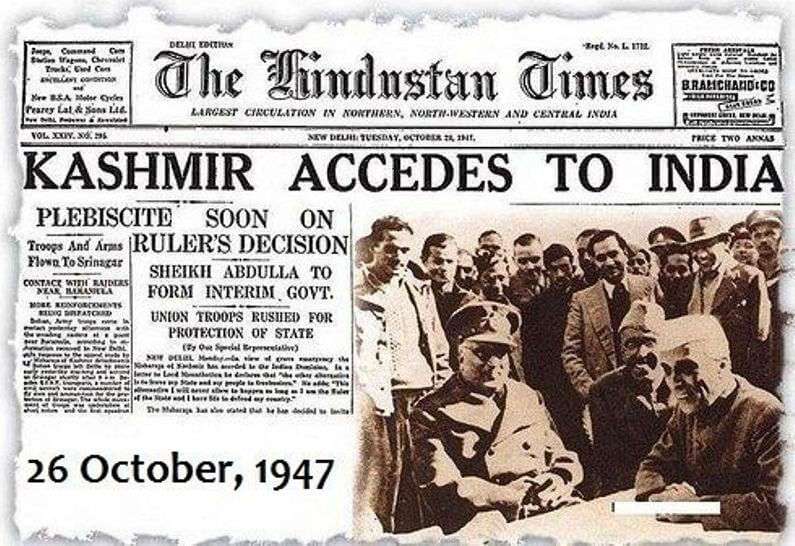
Jammu and Kashmir signs the Instrument of Accession with India
He did not want to merge with India or Pakistan.Hari Singh tried to negotiate with India and Pakistan to have an independent status for his state. He offered a proposal of Standstill Agreement to both the Dominion, pending a final decision on State’s accession. On August 12, 1947, the Prime Minister of Jammu and Kashmir sent identical communications to the Government of India and Pakistan.Pakistan accepted the offer and sent a communication to J&K Prime Minister on August 15, 1947. It read, “The Government of Pakistan agrees to have Standstill Agreement with Jammu and Kashmir for the continuation of existing arrangements …”
India advised the Maharaja to send his authorized representative to Delhi for further discussion on the offer.
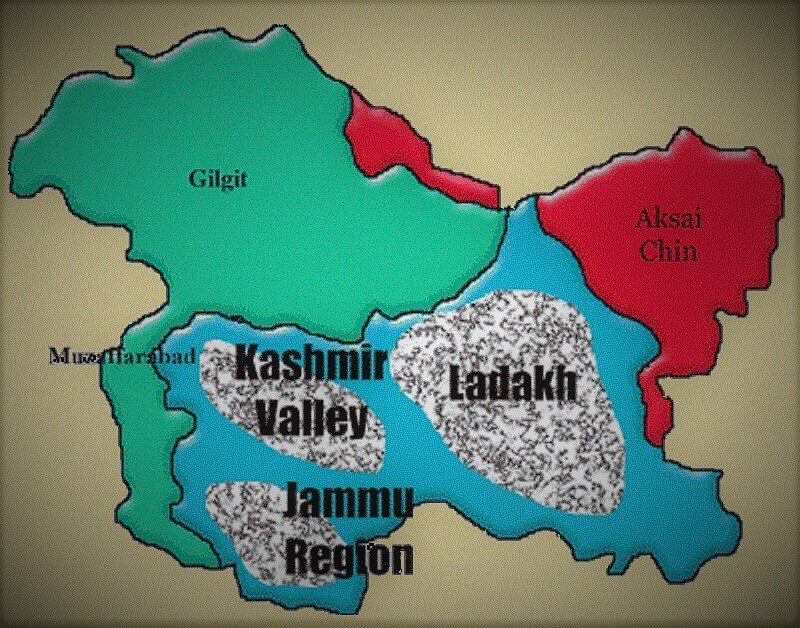
Jammu Kashmir Ladakh

Conclusion

The Kashmir issue – which was once a simple one, has now turned a complex problem to solve. It has multiple dimensions – external and internal; inter-state as well as intra-state. Not even the separatists are on the same ground – their demands are different.
The princely state of Jammu and Kashmir which was under the control of British India – is now not entirely with India. Pakistan and China too  now occupy a significant portion of the terrorities of the erstwhile princely state.
Of course, the Kashmir problem also includes the issue of Kashmiri identity known as Kashmiriyat. However, almost every state in India has its own identity – Tamil Nadu, Karnataka, West Bengal or Kerala. However, the people in each of these states even when seeing themselves as Tamilians, Kannadagans, Bengalis or Malayalis are also able to see the bigger picture – they identify themselves as Indians.The first step to solve the Kashmir issue is to identify the problems behind the alienation of Kashmir. Here are some of them:
  • Mishandling of the Kashmir Issue by the successive Central governments of India – which includes frequent dismissal of State Assemblies.
  • The state governments of Kashmir failed to distribute the benefits of growth and development to every area of the Kashmir.
  • The terrorist and military outfits in Pakistan has been distancing the youth of Kashmir from the democratic form of the Indian government.
  • The regular presence of the Indian Armed Force or CAPF in the Kashmir interiors, and the misuse of provisions like ASFPA.
  • To find a solution to Kashmir issue – all stakeholders should be considered.
    Kashmir was and still is an integral part of India. It has a plural and secular culture – just like the rest of India. Urgent steps should be taken to bridge the gaps of trust deficit in the minds of Kashmiri youth. All Kashmiris should get the due share in the growth story of India. Like all other states in India, there should be adequate political autonomy in Jammu and Kashmir.